🐾 Unregulated adolescent dog? Here’s what to do… Adolescence can be a wonderfully messy stage of dog development. One minute you’ve got a thoughtful young dog who appears to have understood everything you’ve taught them. The next, they’ve spotted a… Show more
🐾 Unregulated adolescent dog? Here’s what to do…
Adolescence can be a wonderfully messy stage of dog development.
One minute you’ve got a thoughtful young dog who appears to have understood everything you’ve taught them. The next, they’ve spotted a leaf moving three gardens away and apparently forgotten you exist. 😅
But this is where I think we need to be careful with words like stubborn, naughty or defiant.
An adolescent dog is going through a significant period of neurological, hormonal and social development. Emotional regulation and impulse control are still maturing, while curiosity, exploration and sensitivity to what’s happening around them can be enormous.
So when a young dog becomes overwhelmed, overexcited, mouthy, barky, zoomy, unable to settle or seemingly unable to listen, my first question isn’t:
“How do we make them behave?”
It’s:
“What does this dog need right now to help them regulate?”
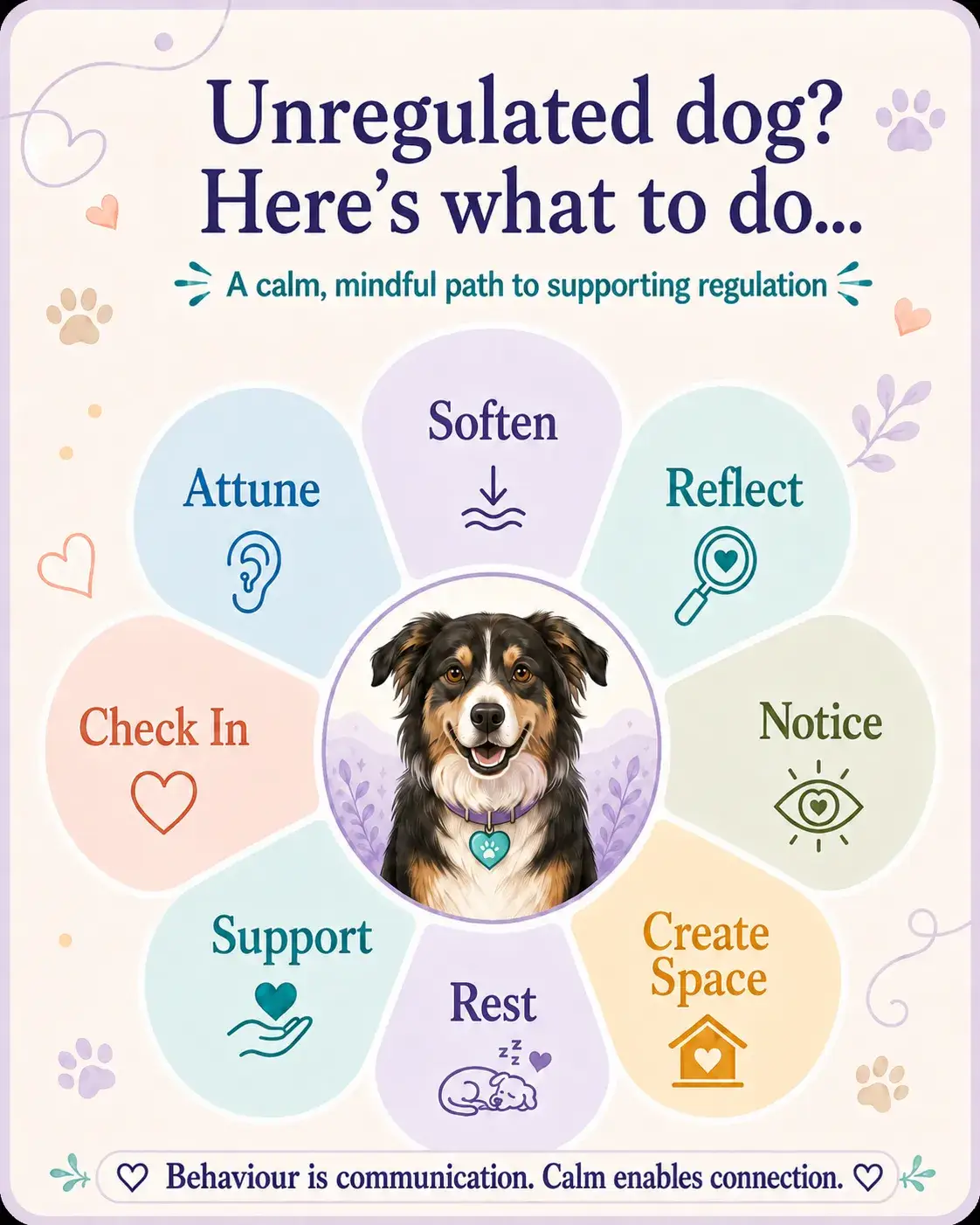
That’s what this flower wheel is about. 💜
• Soften – reduce the pressure. Fewer demands, fewer battles and sometimes simply a quieter day.
• Reflect – look at what’s been happening around the behaviour. Exercise, enrichment, excitement, visitors, walks, daycare… even good things can become too much.
• Notice – watch your dog rather than waiting for the explosion. How are they moving? Breathing? Looking? Can they disengage? Can they settle afterwards?
• Create Space – sometimes regulation needs distance. From another dog, the children, visitors, the window, or simply the constant activity of family life.
• Rest – sleep and genuine downtime matter enormously. An exhausted adolescent isn’t necessarily going to become calmer by doing another hour of exercise.
• Support – help their nervous system find its way back down. Sniffing, chewing, licking, quiet companionship, predictable routines and activities your individual dog finds soothing.
• Check In – behaviour is information. If something has suddenly changed or your dog is struggling unusually, consider discomfort, pain or health alongside behaviour.
• Attune – perhaps the most mindful part of all. Slow yourself down enough to actually listen to the dog in front of you.
And that last one matters.
Because regulation isn’t something we simply teach to a dog.
Very often, it’s something we help them experience.
Our pace, expectations, environment and emotional responses all become part of the picture. Sometimes the most useful thing we can offer an adolescent dog isn’t another command.
It’s a calmer nervous system standing beside them saying:
“I see you. You’re struggling. We’ll work this out together.”
💜 Behaviour is communication. Calm enables connection.
Show less